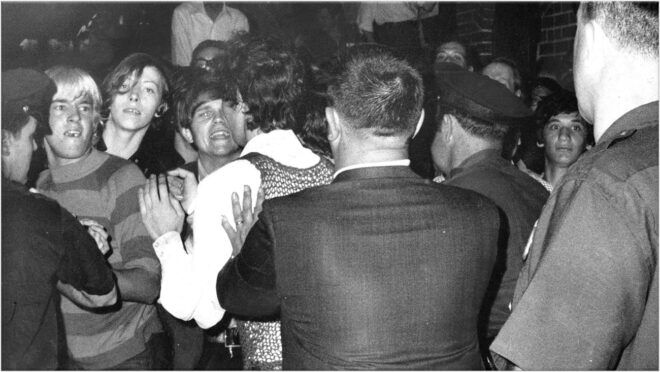
Everything changed at 1:20 a.m. on June 28, 1969, when the New York City police barged into the Stonewall Inn. The Stonewall was operating without a liquor license at 51–53 Christopher Street in Manhattan. The N.Y. State Liquor Authority did not give out licenses to establishments that served gay patrons. Despite being paid off to ignore this indiscretion, the police officers entered with a warrant and started to arrest revelers inside the bar, but their squad cars did not arrive. The Stonewall Inn’s patrons were forced to wait outside the bar, handcuffed, which drew a crowd.
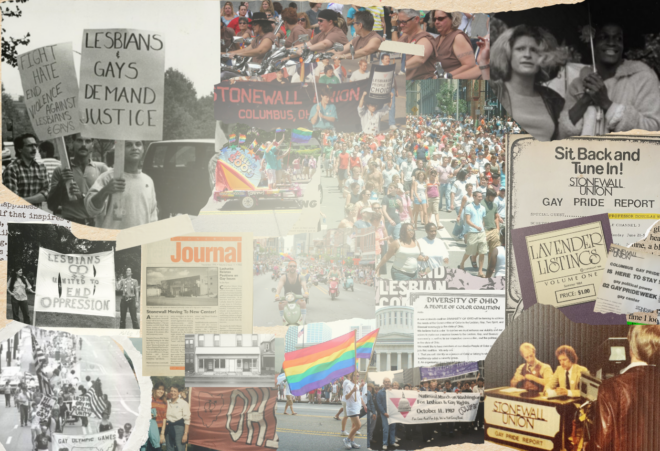
Stonewall Columbus (formerly known as Stonewall Union) was incorporated by local Columbus, Ohio gay activists in 1981, in response to Jerry Falwell’s attempt to establish a Columbus-based Moral Majority headquarters. His attempt failed and over time Stonewall has become a major part of the Columbus LGBTQ+ community. The organization derives its name from the location of the 1969 Stonewall Uprising, the Stonewall Inn, located in Greenwich Village, New York City. The founding members established three primary goals for Stonewall Union: political lobbying and legislative reform, community building, and education.
Stonewall has been integral to the success of many pro-LGBTQ+ rights initiatives, including Governor Richard Celeste’s 1983 executive order protecting the hiring and promotion of gays and lesbians in state jobs; the 1988 Hobson AIDS Bill; and Columbus’ 1992 city ordinance prohibiting hiring discrimination based on sexual orientation.
In the early days Stonewall also published voters’ guides focusing on Gay, Lesbian, Bisexual, and Transgender (GLBT) issues—candidate endorsements as well as support for pro-LGBTQ+ ballot issues. In 1982, they organized the first Columbus gay pride parade, involving over 1,000 people (after expecting less than 400). They also worked as a local organizer for the 1987 March on Washington for Gay and Lesbian Rights.
In addition to an evolving array of programs, Stonewall produces Lavender Listings, a listing of local products and services from LGBTQ+ friendly businesses and organizations, and Columbus Pride; started in 1981, Pride now welcomes over 700,000 visitors to the Columbus region.
As the community has changed, so has Stonewall’s mission and vision—now to “increase visibility, inclusion, and connection for the LGBTQ+ community so we see a community where ALL of US thrive.”
Timeline
1969
Early hours of June 28, 1969 —
Transgender women resist arrest. Bottles are thrown at police. Accounts vary over exactly what kicked off the riots, but according to witness reports, the crowd erupted after police roughed up a woman dressed in masculine attire (some believe the woman was lesbian activist Stormé DeLarverie) who had complained that her handcuffs were too tight. People started taunting officers and throwing pennies, followed by bottles; some in the crowd slashed the tires of police vehicles.
Two transgender women of color, Marsha P. Johnson and Sylvia Rivera, were said to have resisted arrest and thrown the first bottle (or brick or stone), respectively—although Johnson later said in a 1987 interview that she arrived after the uprising was well underway.
While the Compton’s Cafeteria riot (August 1966, San Francisco) occurred prior to this moment, it was the Stonewall Uprisings that ignited the current queer rights movement.
June 29 – July 1, 1969 —
Stonewall becomes a gathering point for LGBTQ+ activists. Over the next several nights, activists continued to gather, taking advantage of the moment to spread information and build the community that would fuel the growth of the gay rights movement.
The lasting impact —
With Stonewall, the spirit of ’60s rebellion spread to LGBTQ+ people in New York and beyond, who for the first time found themselves part of a broader community.
1970
June 28, 1970 —
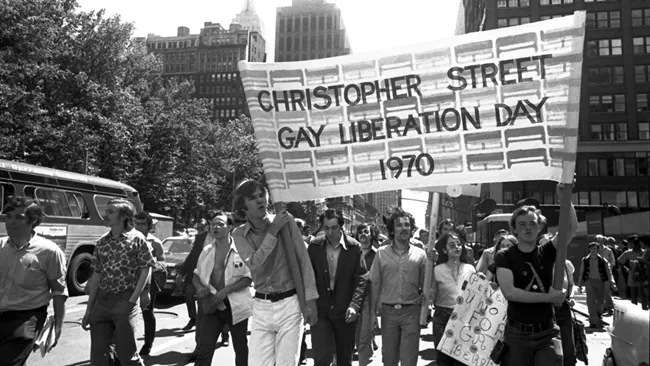
First Gay Pride parade sets off from Stonewall Inn. On the first anniversary of the police raid, activists organized the Christopher Street Liberation March to cap off the city’s first Pride Week. Inspired by New York’s example, activists in other cities organized Pride celebrations that same year.
1980s
June 1981 — The first Pride march in Columbus, Ohio was held in June 1981. Only 200 people were in attendance, and some wore bags over their heads to conceal their identities.
September 1981 — Stonewall Union (now known as Stonewall Columbus) was incorporated by local Columbus, Ohio gay activists. The organization was formed in response to Jerry Falwell’s attempt to establish a local Moral Majority headquarters here.
June 1982 —
“[T]he first official Pride [march] in Columbus occurred on June 26, 1982. There were smaller demonstrations prior to 1982, but nothing officially recognized.”
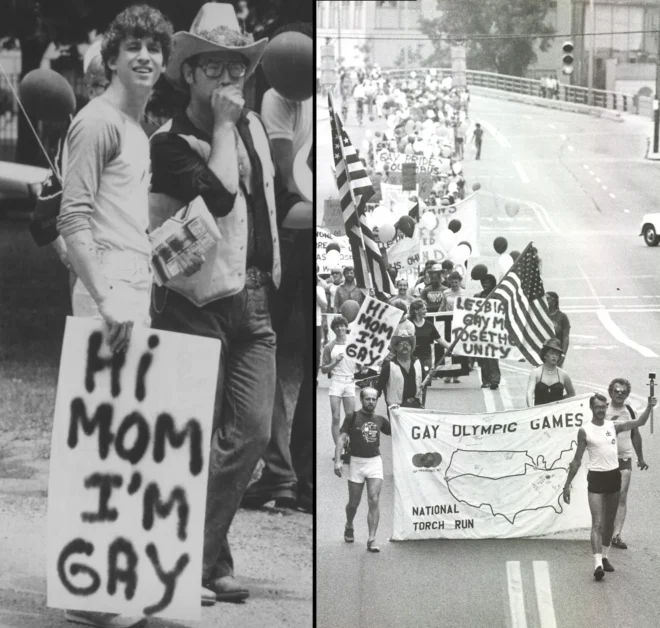
In the 1970s, before events became more commonplace, small marches would take place through downtown Columbus. Some participants wore bags over their heads so they would not be recognized. Very few protections existed for the LGBT community then, so a public outing could be very detrimental. In 1982, Columbus City Council passed a resolution recognizing Gay Pride Week (13 years after the Stonewall Uprisings) and allowed the march/parade to take place.
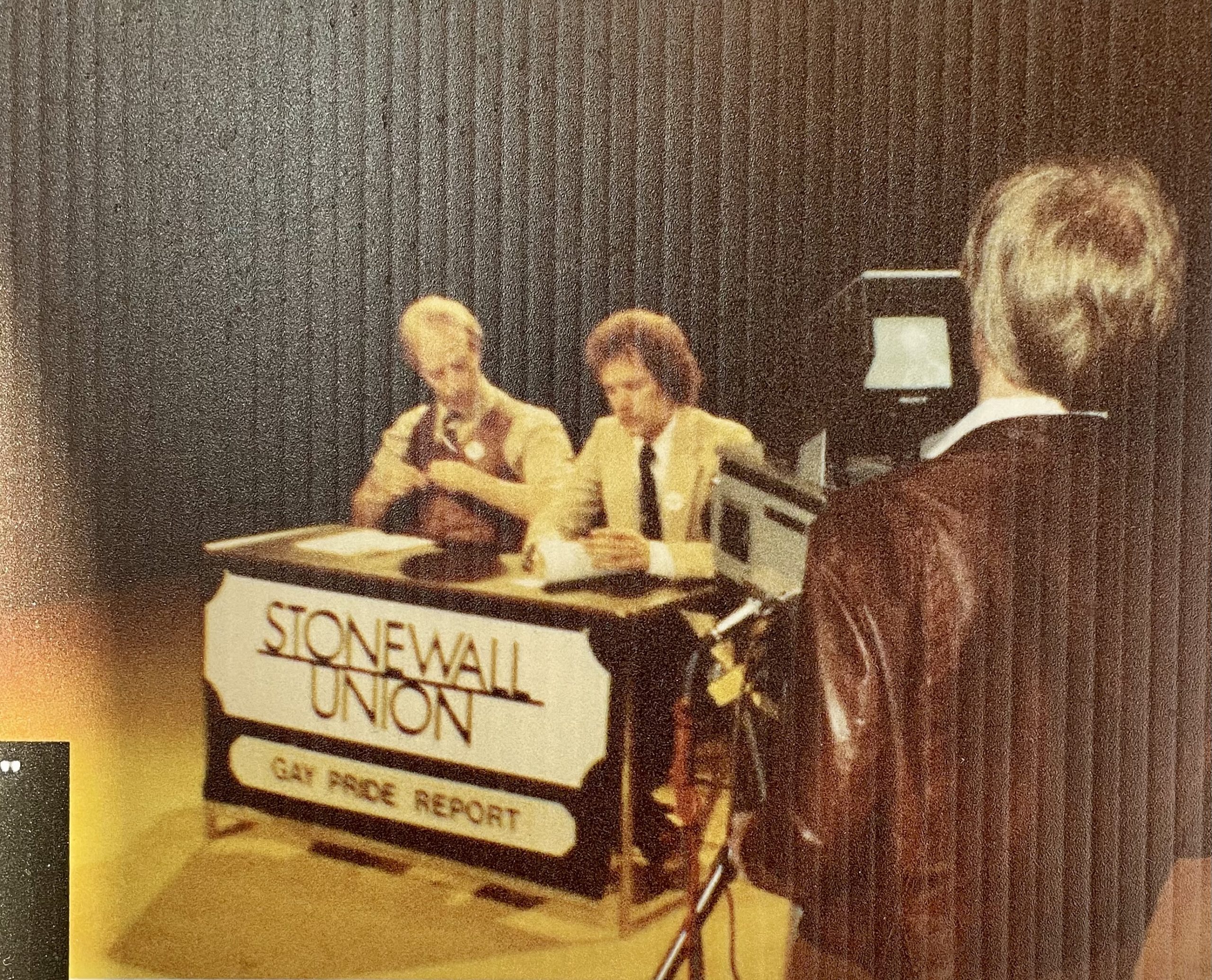
1982 — Stonewall Union began producing the Gay Pride Report on ACTV.
- 1983 — Stonewall Union aided in the development of the Governor’s Executive Order banning discrimination on the basis of sexual orientation in state employment.
- 1984 — First Lavender Listings published.
- 1984 — Stonewall Union hosts first Gay and Lesbian Conference.
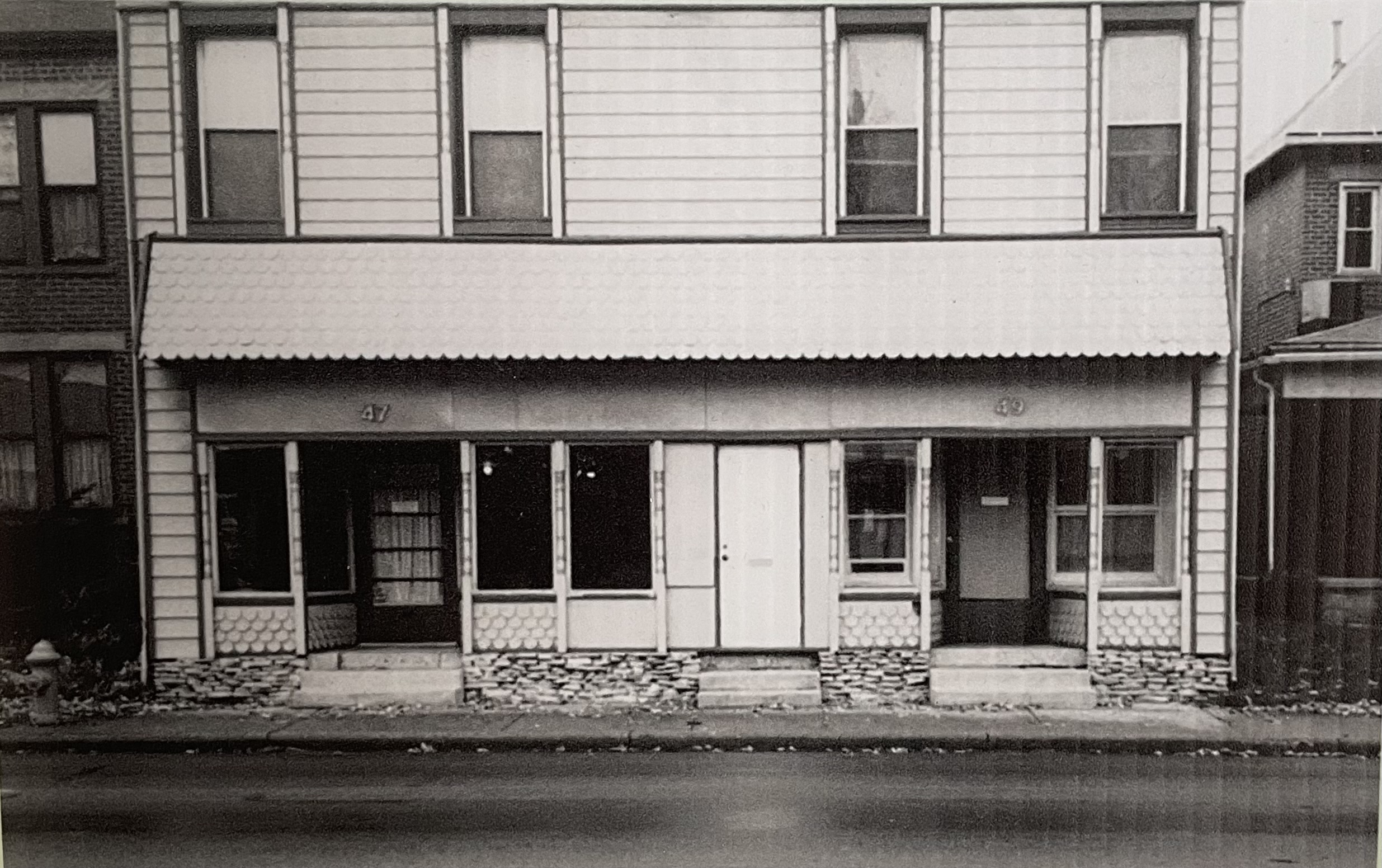
1985 — The organization moves into its first building, becoming the first LGBT organization in the state to have its own facility. Prior to this the organization’s address was a PO Box.
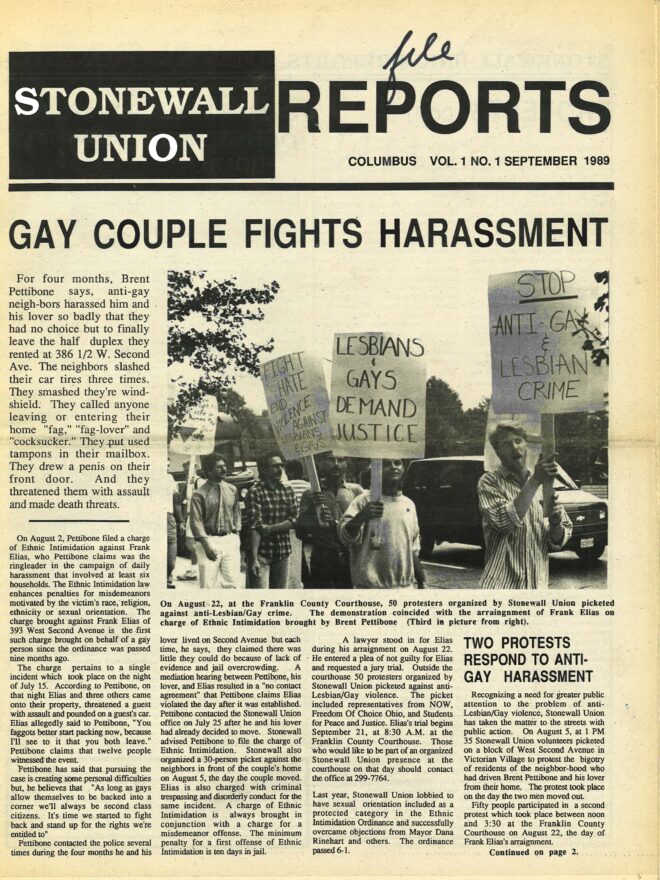
1989 — In September, The Stonewall Union Reports launches.
1990s
February 1991 — The Anti-Violence Project (now known as BRAVO) was created at Stonewall.
September 1991 — The Stonewall organization celebrates 10 years of service to the community.
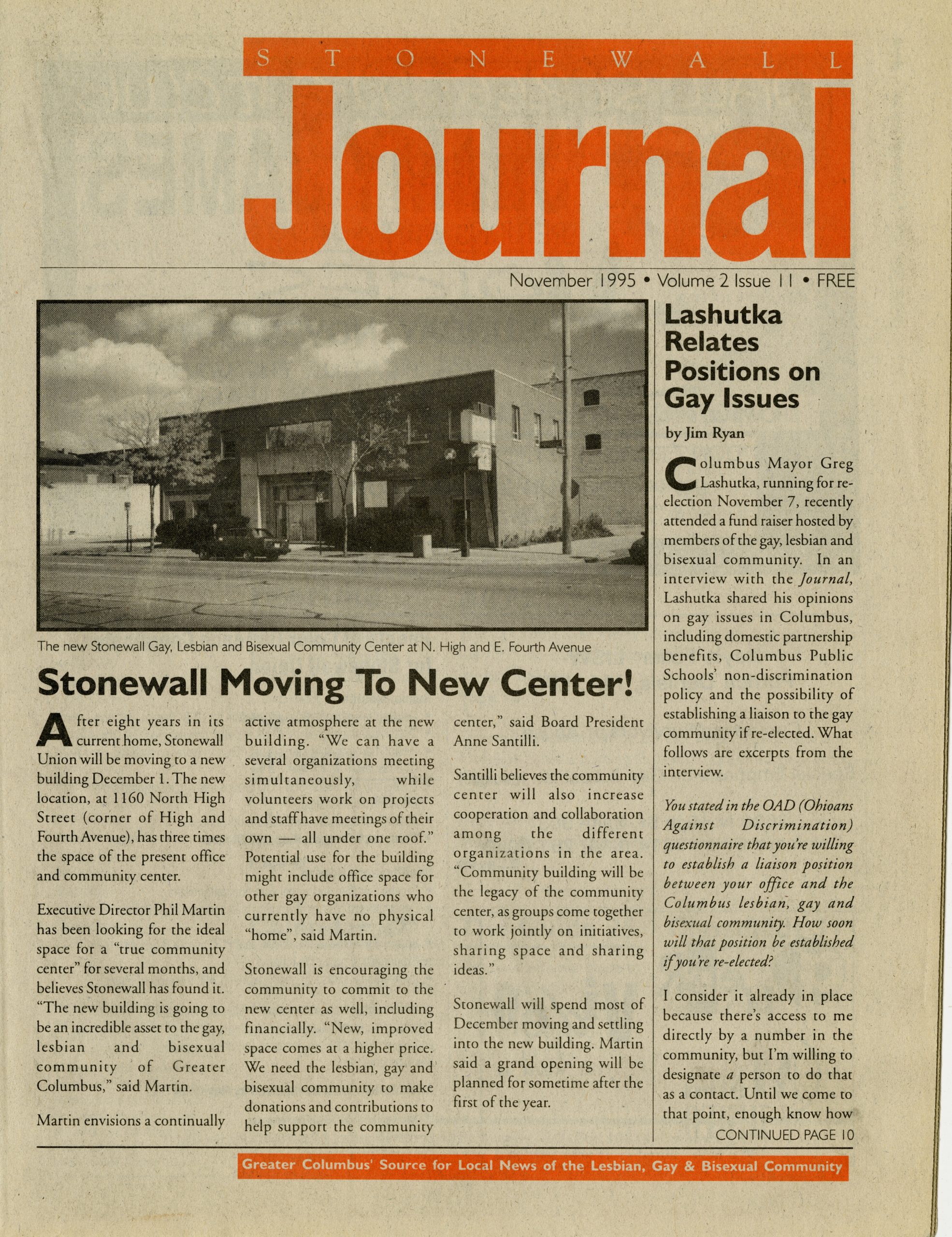
December 1995 — Stonewall Columbus moved into its current location at 1160 N. High Street and opened the Stonewall Columbus Community Center.
June 11, 1999 — President Bill Clinton issued the first-ever proclamation declaring June to be Gay and Lesbian Pride Month. His successor, George W. Bush, did not continue the tradition. The practice was picked up again by Barack Obama, who declared June LGBT Pride Month all eight years of his administration.
2000s
September 2001 — The Stonewall organization celebrates 20 years of service to the community.
2005 — Stonewall Columbus purchased the building it was renting and an adjacent structure on the corner of 4th and High streets to plan for the expansion of services to meet community need and to create the first LGBT community center in Central Ohio. After a recommendation from Councilwoman Charleta Tavares, Columbus City Council approved funding to repair both buildings in the first of several stages of restoration that began in 2006. Over the period of three years with help from the city and a few major donors, Stonewall Columbus made approximately 3,200 square feet of space usable for the community and began restoring the adjacent vacant warehouse space called the 4th Street Annex.
2010s
September 2011 — The Stonewall organization celebrates 30 years of service to the community.
2013 — Stonewall Columbus launched the capital campaign STONEWALL BUILDS to renovate and connect the two buildings at N. High St. and 4th Ave.
November 2014 — Stonewall Columbus proclaimed November LGBTQ Veterans Recognition Month.
June 26, 2015 — The Supreme Court decision in Obergefell v. Hodges granted marriage equality nationwide.
June 24, 2016 — President Obama established the Stonewall National Monument.
2017
Black Pride Four — #BlackPride4
A group of protesters blocked the path of the 2017 Pride Parade in downtown Columbus in hopes of holding a 7-minute moment of silence for slain Minnesota man Philando Castile. They said it was also “an effort to raise awareness about the violence against and erasure of black and brown queer and trans people, in particular the lack of space for black and brown people at pride festivals.”
Four of those protesters—Kendall Denton, Ashley Braxton, Wriply Bennett, and Deandre Miles—were arrested following a confrontation with police. They would come to be known as the Black Pride 4.
Denton, Braxton and Miles were found guilty of six of eight misdemeanor charges and sentenced to community service and probation.
Amid this time the longest-serving Stonewall Executive Director Karla Rothan retired from her position in March of 2018.
“A lot of people of color feel uncomfortable at mainstream prides mainly cause there are a lot of police both in uniform and undercover and when you’re in a spot that is highly police that can lead to violence on people of color,” said BQIC founder Ariana Steele.
(Stonewall Columbus apologizes for 2017 Black Pride 4 arrests – 10/30/2019)
Since 2017, Stonewall Columbus has issued several statements regarding the June 2017 protest at its Pride march:
- A Message to the Community from the Executive Director & Board of Trustees — October 2019
- Interim Executive Director Statement: Moving Toward Repair — June 2022
2018
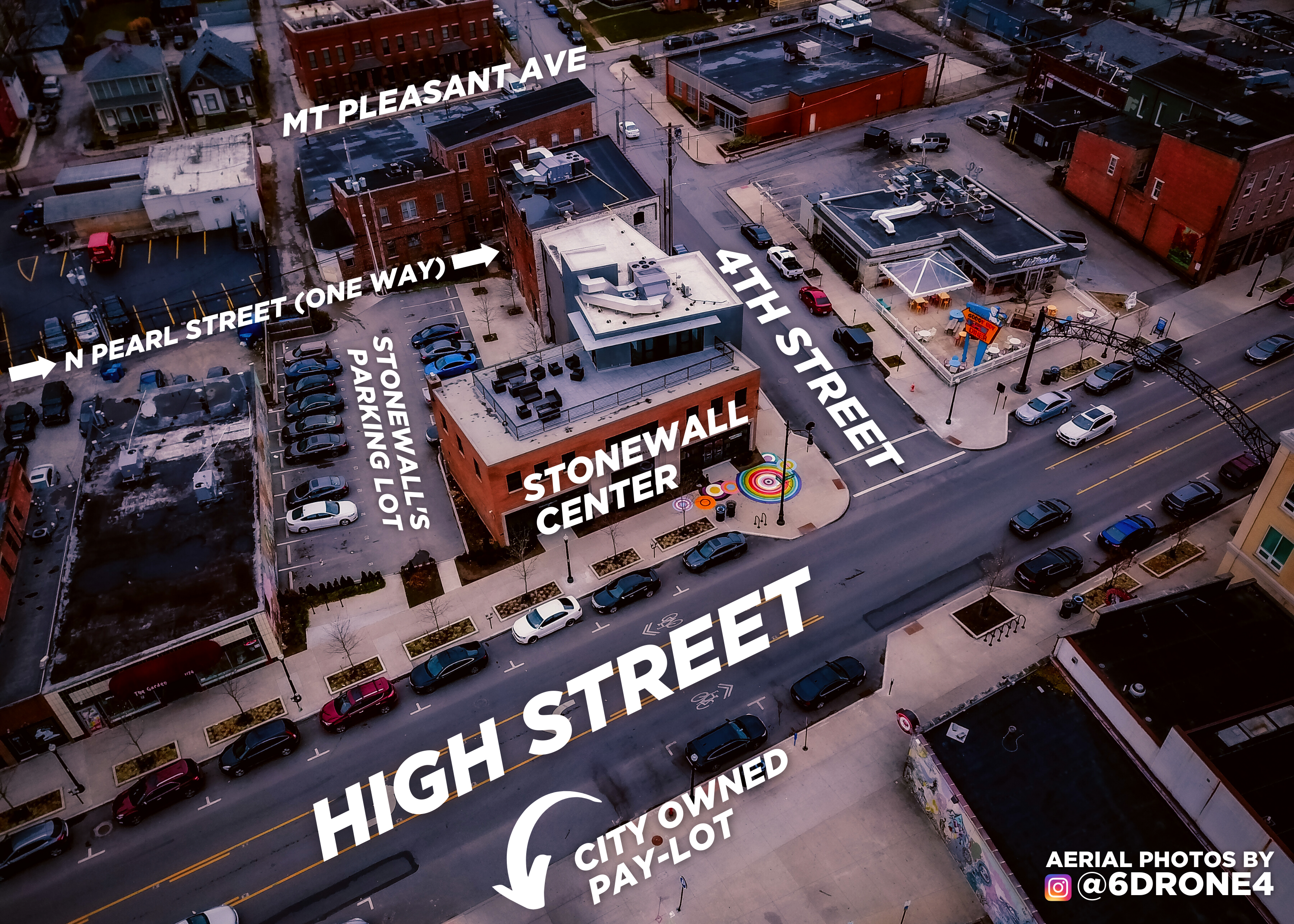
In 2013, the Stonewall Builds capital campaign began to renovate and connect the buildings. Renovation started in 2017, and the building reopened in December 2018.
Stonewall Columbus set out on a journey to raise funds to help revamp the Center on High in an effort to evolve services and better meet the needs of the LGBTQ+ community; in 2017 renovation and remodeling began and in December of 2018 the building reopened as the Stonewall Columbus Community Center — The Center.
2020
COVID-19 forced cancellation of in-person Pride events across the globe. Stonewall Columbus Pride events were postponed to October and then became virtual as the pandemic continued to create challenges to large public gatherings.
In October 2020 Stonewall Columbus presented Stonewall Columbus Pride Parades of History over the course of four weekends in October.

2021

In 2021, Family Pride Network and Stonewall Columbus merged and continued operations under the Stonewall name with FPN becoming Family Pride Network | A program of Stonewall Columbus.
September 2021 — Stonewall celebrated 40 years of service.
2022
Stonewall Columbus and the Central Ohio region celebrated a return to in-person Pride events with the largest Pride celebration in the Midwest welcoming over 17,300 registered marchers and an estimated 750,000 people in attendance during the two-day Pride Festival in downtown Columbus.
2025
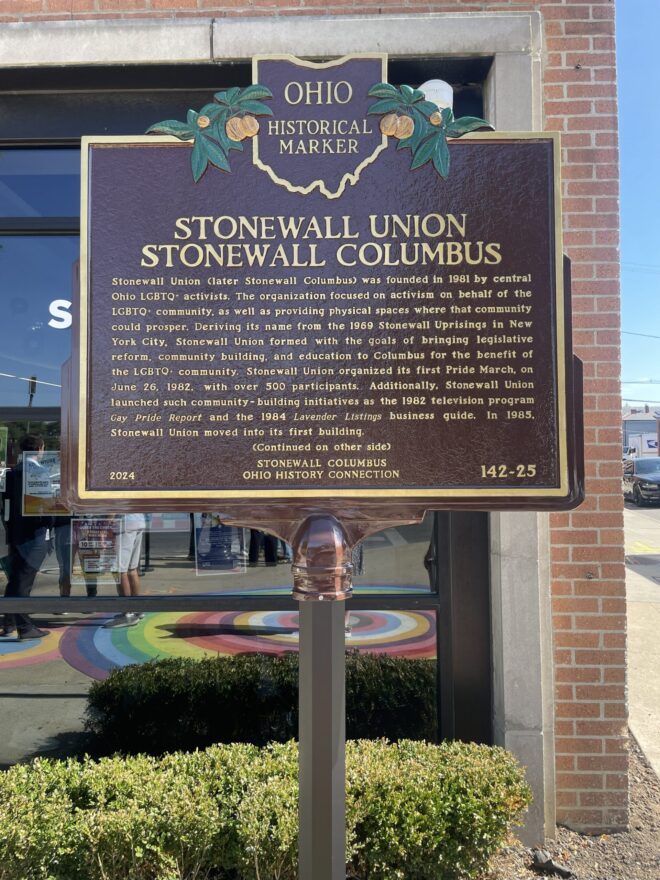
On October 4, 2025 Stonewall unveiled an Ohio Historical Marker, only the fourth in the state dedicated to LGBTQ+ history.
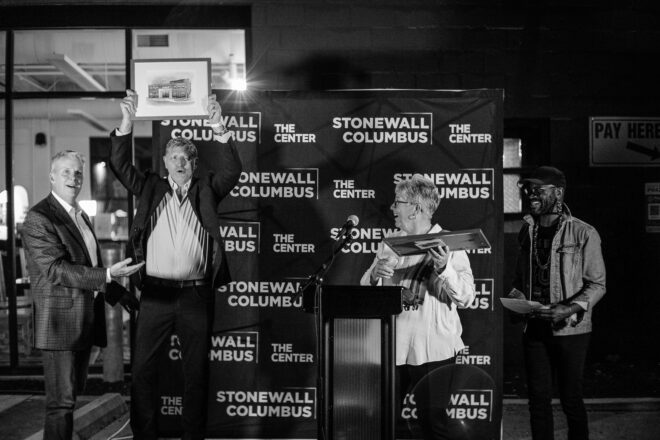
(L to R) Rick Neal, Tom Grote, Lynn Greer, and Executive Director Densil Porteous celebrate during Come Out for Stonewall and the 2025 Greer/Grote Endowment announcement.
At the 4th annual Come Out for Stonewall celebration, the establishment of the Stonewall Columbus Greer/Grote Building Endowment Fund—a transformative $500,000 gift from Lynn Greer, Tom Grote, and Rick Neal—was announced. The fund aims to ensure the community center remains open, safe, and welcoming for generations to come.
The Future
As a community organization and center, Stonewall aims to exist as a fulcrum in a dynamic ecosystem of LGBTQ+-centered nonprofits—organizations like Black, Out & Proud, Equality Ohio, Kaleidoscope Youth Center, and TransOhio that work to support our various identities, as well as healthcare organizations like Central Outreach Wellness and Equitas Health, focused on creating a space of LGBTQ+ affirming healthcare.
Our shared experiences as LGBTQ+ people unite us in our story, and it should be our individual right to happiness that binds us in our fight for equity, equality, and liberation. At our core each of us wants to be seen as valued individuals who are part of a larger community; a community that if not embraces, at least respects our individuality.