
Researched By: Eugene Rutigliano, Columbus Metropolitan Library
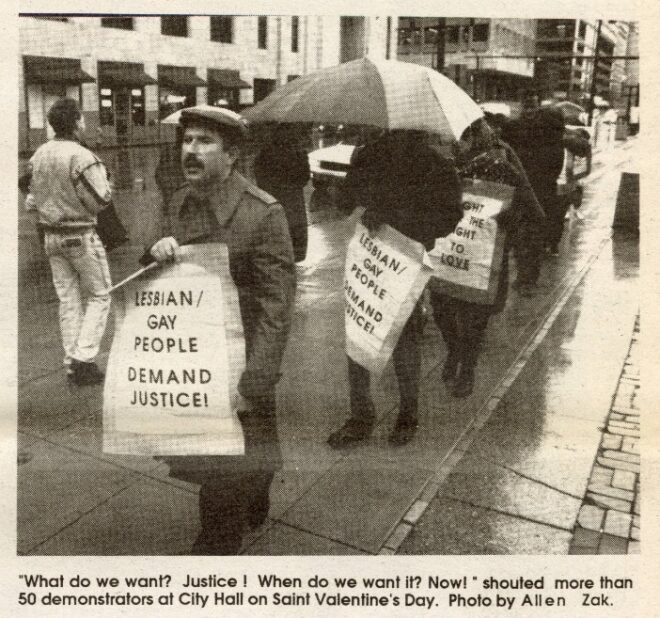 On Valentine’s Day 1990, some 50 people gathered at City Hall for a protest organized by Stonewall Union, the Columbus-based LGBTQ+ community organization, in the aftermath of Harrison West resident Frank Elias’s acquittal. Elias had been charged in Franklin County Municipal Court with disorderly conduct and ethnic intimidation by neighbor Brent Pettibone stemming from an alleged July 15, 1989 altercation.
During trial, Pettibone and two other witnesses called by the assistant city prosecutor Marcie McCreary testified that Elias had disrupted a party hosted by Pettibone’s downstairs neighbor Carey Herbster at his apartment. Elias threatened to “see to it” that Pettibone, his boyfriend, and other queer attendees leave the neighborhood or he would kill them. The incident, Pettibone alleged, fit a pattern of escalating menace that included vandalism, verbal harassment including derogatory language, and general hostility in Elias’s interactions with him and his boyfriend. Eventually, Pettibone left the neighborhood because, he said, he feared for his life. Elias denied threatening to kill the partygoers and downplayed the intensity of his interactions with Pettibone. He defended his confrontations with his new neighbors by saying “[Pettibone and his boyfriend] kissed the first day they moved into the neighborhood…they were trying to push [their lifestyle] down our throats,” and “I told [Pettibone’s boyfriend] to find another place to live if they continued to carry on like this. They brought all this on themselves.” Elias also alleged that Pettibone was attempting to provoke his neighbors by showing affection towards his boyfriend in public as a means of getting the ethnic intimidation ordinance tested in court with Stonewall Union’s help. The weeklong trial ended with just a 70-minute deliberation by the jury and a not guilty verdict for Frank Elias.
The case represented the first time the sexual orientation provision of Columbus’s ethnic intimidation ordinance was applied. While it was only allowed to be used as an attachment to misdemeanor charge, an ethnic intimidation conviction would have resulted in a heightened maximum sentence of six months in jail and a $1,000 fine. The ordinance, passed in December 1988, prohibits intimidation based on race, color, religion, national origin, or sexual orientation. The inclusion of the latter provision in the ordinance was itself controversial. Mayor Dana Rinehart argued that the “sexual orientation” terminology was too vague and implored City Council to remove it before passage. When the ordinance passed with the sexual orientation provision included, Rinehart elected not to veto it.
The Valentine’s Day protest at City Hall pointed its critique not at the tactics used by Elias and defense attorney Clarence T. Gordon during the trial. Instead, the day of the protest was coordinated with a letter Stonewall Union delivered to the Mayor, City Council, and City Attorney’s office with several complaints about the conduct of the prosecution, which Stonewall members described as “mechanical and dispassionate in the extreme.” To the organization, the City Prosecutors’ handling of the charges reflected a negligence of or discomfort with the ordinance that stunted their approach to the trial. The letter offered as an example the lack of a rebuttal to the defense’s allegation that Stonewall and Pettibone were colluding to drum up a bogus charge against Elias for publicity (Stonewall contended that it only started working with Pettibone after the party incident in July and after he had already decided to move away). That the prosecutor’s office led some of the party incident witnesses to file charges against Elias that did not include the ethnic intimidation element was also perceived to weaken Pettibone’s case. The criticisms were aimed at preventing similar issues from handicapping efforts to uphold the law in the future. At the protest, Stonewall Executive Director Michael McFadden told the Lantern, “this is to bring attention to the fact that something is wrong and we’re asking [city officials] to take a leadership role, and we trust that they will.” The letter concludes with a suggestion that queer people need to be more involved in the political processes that may make the legal system work more effectively for marginalized communities.
In spite of challenges to its constitutionality, including a case appealed to the Ohio Supreme Court in 2019, the city’s ethnic intimidation ordinance remains a part of Columbus law. It has most recently been deployed in charges against two women alleged to have vandalized the building housing the Ohio State University chapter of Hillel, a Jewish student organization, on November 9, 2023.